
The Ritual Dialect of the Silicon Pantheon: Linguistic Convergence Among AI’s Visionaries
- BusAnthroInc

- Apr 27
- 4 min read
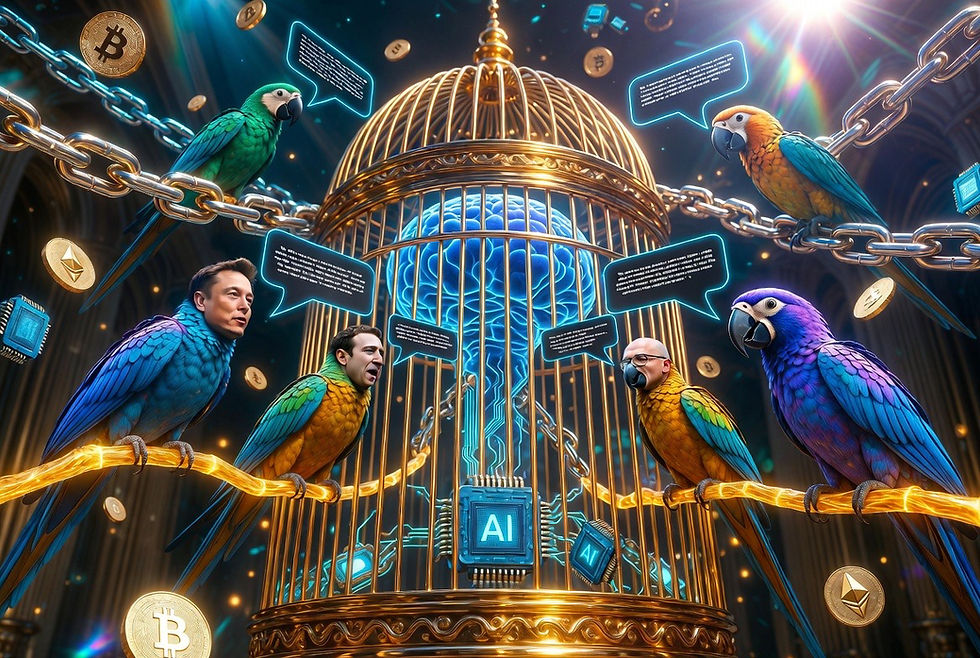
In the rarefied world of artificial intelligence development, a curious linguistic phenomenon has taken hold. The high priests of the industry speak with a striking uniformity. These include Elon Musk of xAI, Mark Zuckerberg of Meta, Sam Altman of OpenAI, Demis Hassabis of Google DeepMind, Dario Amodei of Anthropic, Jensen Huang of Nvidia, and Satya Nadella of Microsoft. Public statements, keynote addresses, congressional testimonies, and podcast appearances reveal near-identical phrasing that transcends individual corporate agendas. This is no accident of coincidence. It is the ritual dialect of a modern business tribe; a shared vocabulary that both signals membership and constructs reality.
Observe the recurring incantations. Across platforms and years, the same core phrases surface verbatim or in near-verbatim form: “We are on the cusp of artificial general intelligence”; “This is the most transformative technology humanity has ever created”; “The progress is exponential”; “Scaling compute will unlock new frontiers of intelligence”; “We must ensure AI is aligned with human values”; “The next few years will define the future of our species”; and “AI will solve problems we cannot even imagine today.” These are not casual overlaps. In compiled public records, one hears Musk, Zuckerberg, Altman, Hassabis, Amodei, Huang, and Nadella deploying these formulations in lockstep. This occurs sometimes within weeks of one another, often with the same measured cadence and optimistic gravitas.
From an anthropological perspective, this convergence functions as a sacred dialect, much like the specialized argot of shamanic lineages or the liturgical Latin of medieval clergy. In business anthropology, language is never neutral; it is a technology of power. Here, the jargon performs three interlocking roles: boundary maintenance, myth-making, and legitimacy engineering.
First, it maintains boundaries. To speak the dialect fluently is to declare oneself an insider in the AI pantheon. Outsiders reveal themselves as profane. These include regulators, journalists, or rival executives who stumble over “alignment” or misuse “scaling laws.” The phrases operate as shibboleths, filtering who belongs in the inner circle of those shaping the intelligence explosion. Musk’s xAI, Zuckerberg’s open-source Llama push, Altman’s iterative GPT releases, Hassabis’s AlphaFold breakthroughs, Amodei’s constitutional AI safeguards, Huang’s GPU empire, and Nadella’s Azure infrastructure all compete fiercely for talent, capital, and mindshare. Yet they speak as one when invoking the dialect. This linguistic solidarity masks commercial rivalry while reinforcing collective elite status.
Second, the shared phrases construct a founding myth. The narrative arc is consistent: humanity stands at a singular inflection point; intelligence itself is now engineerable; the stakes are civilizational; utopia or extinction. By repeating these formulations, the tech gods do not merely describe technical realities. They enact a cosmology in which they are the necessary prophets. “Exponential” invokes Moore’s Law’s successor, the scaling hypothesis; “alignment” frames moral philosophy as an engineering problem solvable by the same minds building the systems; “transformative” elevates AI above electricity or the internet in historical importance. The myth is self-reinforcing: investors fund it, talent flocks to it, governments regulate (or fail to regulate) it precisely because the priests have made the story coherent and urgent.
Third, the dialect engineers legitimacy in the public square. In an era when AI development occurs behind closed labs yet shapes global labor markets, geopolitics, and existential risk discourse, uniform messaging presents a united front. When Musk, Zuckerberg, Altman, and their peers all warn of “existential risk” while simultaneously racing to build the technology, the apparent contradiction dissolves in the shared language. The phrases allow them to occupy both the role of cautious steward and relentless innovator. Regulators hear concern; markets hear opportunity. The dialect thus becomes a sophisticated form of political and economic signaling. It is soft power dressed in technical neutrality.
Why this convergence now? Business anthropology offers several layered explanations rooted in social structure rather than conspiracy.
The first is structural isomorphism. The AI industry operates in a hyper-competitive yet tightly networked environment. Leaders attend the same conferences, serve on the same advisory boards, read the same foundational texts (Bostrom’s *Superintelligence*, Russell’s *Human Compatible*, the original transformer paper), and compete for the same scarce resource: elite machine-learning talent. In such conditions, organizations and their spokespeople tend to adopt similar forms, rhetoric, and strategies (a phenomenon documented in institutional theory since DiMaggio and Powell’s 1983 work on organizational fields). The dialect spreads through mimetic pressure: what works for one (attracting capital, calming regulators, inspiring researchers) is rapidly copied by all.
The second is the echo-chamber effect of elite geography and social capital. The Bay Area, London’s AI corridor, and the virtual salons of X and private Signal groups create intense social density. When five or six men control the frontier models that will shape the century, their dinner conversations, leaked emails, and off-the-record briefings homogenize worldview. The phrases become social glue. They reassure one another that their unprecedented power is both inevitable and benevolent.
The third is performative necessity in the attention economy. In a world of short attention spans and algorithmic amplification, only certain phrases reliably cut through. “Exponential progress” triggers investor dopamine; “humanity’s future” triggers media coverage; “alignment” signals seriousness to policymakers. The dialect is optimized for virality and stakeholder management. Individual nuance is sacrificed for collective resonance.
Critically, this linguistic uniformity is not evidence of puppet-master coordination. It is emergent culture. This is deeper and more interesting than conspiracy. It reveals how modern capitalism, when fused with existential technology, produces its own priestly class complete with sacred vocabulary. The AI tech gods are not merely executives; they are myth-makers whose words shape material reality. Their shared phrases do not just describe the future; they summon it by aligning capital, talent, policy, and public imagination behind a singular vision.
Yet the anthropological lens also raises an uncomfortable question: what happens when an industry’s leaders speak as one? Historical parallels suggest that linguistic convergence often precedes both spectacular creation and spectacular correction. These parallels range from the railroad barons’ shared rhetoric of manifest destiny to the dot-com era’s universal invocation of “eyeballs” and “first-mover advantage.” Uniform language can accelerate progress by focusing collective effort. It can also blind the tribe to blind spots: over-optimism about timelines, underestimation of societal disruption, or the assumption that technical solutions suffice for philosophical problems.
In the end, the ritual dialect of Musk, Zuckerberg, Altman, Hassabis, Amodei, Huang, and Nadella tells us less about artificial intelligence than about human institutions. Even at the frontier of god-like technology, the oldest rules of anthropology still apply: groups create language, language creates groups, and the stories we tell together determine who holds power. The AI pantheon has found its liturgy. The rest of us now live inside the world those words are building.


Comments